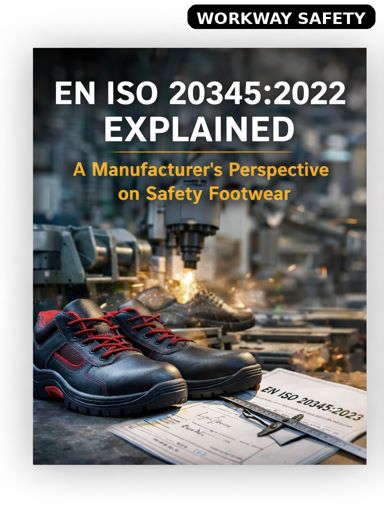
EN ISO 20345:2022+A1:2024 Explained — A Manufacturer’s Perspective on Safety Footwear What European PPE buyers should understand beyond the certificate For a safety footwear buyer, EN ISO 20345 is easy to see as a certification requirement. Choose the required protection class, develop the shoe, send samples for testing, obtain certification, and move into production. From a manufacturing perspective, however, this sequence misses an important point: The standard does not only influence what a finished shoe must achieve. It influences many of the decisions made before the shoe exists. Toe protection, puncture resistance, outsole construction, upper materials, water resistance, slip performance and optional claims all have consequences for product design, component selection and production control. And those consequences continue after certification. A certificate confirms a defined product construction. It does not remove the need to control what happens to that construction during later production. First, a Naming Point: Why Do You See 2021, 2022 and 2024? This causes understandable confusion. The international standard is published as ISO 20345:2021, with Amendment 1 published in 2024. In European adoption, buyers commonly encounter EN ISO 20345:2022+A1:2024; BSI currently lists BS EN ISO 20345:2022+A1:2024 as its current release. So these dates do not necessarily refer to competing safety footwear standards. They reflect different stages and forms of publication and adoption. For European sourcing projects today, the practical reference should therefore consider the 2022 European edition together with A1:2024, rather than treating the original 2022 text as the end of the story. SATRA likewise references EN ISO 20345:2022+A1:2024 in its current technical material. What Changed Compared With the Previous Generation of EN ISO 20345? The change from the 2011 generation was more than a renaming exercise. Several changes directly affect how products are specified. Among the most commercially visible are: revised slip-resistance requirements and the new SR marking; separate P, PL and PS approaches to puncture resistance; new S6 and S7 categories for whole-footwear water resistance; WPA replacing the previous WRU terminology; FO becoming an additional requirement rather than being automatically embedded in S1-S5 classifications; additional requirements such as SC for scuff-cap abrasion and LG for ladder grip. For buyers, the important question is not simply: “What do the new letters mean?” A more useful question is: “What product decisions are hidden behind those letters?” That is where the standard begins to affect manufacturing. Slip Resistance: Basic Requirement and SR Are Not the Same Thing This is one area where the terminology can easily cause misunderstanding. Under the revised standard, an initial slip-resistance condition is part of the basic requirements for applicable footwear. SATRA describes this as testing on ceramic tile with a dilute sodium lauryl sulphate solution. The additional SR marking covers a different condition: ceramic tile with glycerine. The previous SRA, SRB and SRC markings are no longer used in the same way; SR is now the additional marking buyers commonly see alongside classifications such as S1PS or S3S. This distinction matters commercially. A buyer should not treat “slip resistant” as a single universal property. Slip performance depends on the combination of: outsole compound, tread geometry, contact area, edge design, processing consistency, and the actual floor and contaminant conditions in use. Passing a laboratory slip test does not mean one outsole is equally suitable for every slippery workplace. For example, footwear intended for food preparation, industrial floors and outdoor construction may all require different practical priorities even if the products sit within the same general safety-footwear standard. That is why outsole selection should begin with the working environment, not with the marking alone. P, PL and PS: “Non-Metallic Midsole” Is No Longer Enough Information Puncture resistance is another important change. The revised system distinguishes between: P — metallic penetration-resistant insert; PL — non-metallic insert tested using a larger 4.5 mm nail; PS — non-metallic insert assessed using a smaller 3.0 mm nail and its corresponding test criteria. This is why modern classifications include designations such as S3L, S3S, S7L or S7S. For a buyer, this adds useful information. In the past, saying that a shoe used a “composite” or “textile” anti-penetration midsole could sound sufficiently descriptive. It no longer tells the whole story. The protection claim, construction, flexibility, weight, thickness and manufacturing suitability need to be considered together. The technically highest specification is not automatically the right commercial specification for every product. A lightweight indoor safety trainer and a heavy outdoor waterproof boot may reasonably make different choices. This is exactly where standards knowledge should support product positioning rather than replace it. S6 and S7: Water Resistance Is Now More Visible in the Classification System The revised standard introduced S6 and S7 categories associated with whole-footwear water resistance. This is especially relevant to products using waterproof membranes. But from a manufacturing perspective, adding a membrane is not simply adding another material to the BOM. Whole-footwear water resistance depends on the complete construction: membrane design, seam construction, bootie or sock structure, lasting operations, attachment processes, and areas where components or stitching can compromise the barrier. A shoe can therefore contain a waterproof membrane without automatically becoming a well-controlled waterproof footwear system. That distinction matters when developing S7 / S7L / S7S products. FO, WPA, SC and LG: Optional Claims Should Follow Real Use One of the useful effects of the revised system is that certain properties are more explicitly separated. For example, FO is now an additional fuel/oil-resistance claim rather than automatically being part of S1-S5. WPA replaces the older WRU terminology, while SC and LG address defined scuff-cap and ladder-grip requirements. From a product-development perspective, that encourages a question we think buyers should ask more often: Does this feature solve a real end-user requirement, or are we adding it simply because the marking looks stronger? More markings are not always better. Each additional requirement can influence: material choice, outsole design, product weight, testing, manufacturing complexity, cost, and future change flexibility. For some products, a higher specification creates clear market value. For others, it creates cost and complexity that the end user does not need. Compliance should define what the product must prove. Product strategy should define what the product actually needs. A Certificate Is Evidence of Compliance — Not a Substitute for Production Control This is perhaps the most important manufacturing point in the entire discussion. EU PPE Regulation 2016/425 governs the design and manufacture of PPE placed on the EU market and requires applicable PPE to meet essential health and safety requirements. EUR-Lex Testing and certification therefore matter. But production does not stop changing after the certificate is issued. Over the life of a footwear program: a rubber supplier may adjust a formulation; a microfiber specification may be replaced; a toe cap supplier may change; a waterproof membrane may be updated; a buyer may request another colour or variant; a production process may be modified. Not all changes have the same significance. But they should not all be treated as automatically insignificant either. A certificate answers: Did the assessed construction meet the applicable requirements? Production control must continue asking: Are we still making the construction that was assessed? These are different questions. “Equivalent Material” Is a Manufacturing Term, Not a Visual Judgement One recurring sourcing risk is the phrase: “It is basically the same material.” Two materials can have the same commercial description and similar appearance but behave differently in manufacturing. A different microfiber may vary in backing, thickness or lasting behaviour. Two rubber compounds can both be called rubber while differing in formulation and processing characteristics. A different penetration-resistant insert may affect flexibility, thickness and construction. For non-critical decorative components, equivalent substitution may be straightforward. For components related to an assessed product construction, equivalence deserves a more disciplined review. The point is not to make every change difficult. The point is to know which changes matter before production decides for you. What Should European Buyers Ask Their Safety Footwear Supplier? Instead of only asking: “Do you have an EN ISO 20345 certificate?” consider asking: Which version and amendment is the product assessed against? What exactly does the protection classification cover? Is SR required for the intended workplace? Is the penetration-resistant component P, PL or PS? Which materials and components are considered critical to the approved construction? What happens when one of those materials becomes unavailable? Which changes require buyer approval or technical reassessment? How are repeat orders kept aligned with the approved product? How are new colourways or related variants reviewed? These questions do not replace certification. They reveal whether certification is integrated into the manufacturing system. A Manufacturer’s Perspective: The Standard Should Enter the Project Before the Laboratory Does At Workway, we believe compliance decisions should begin during product definition, not when the finished sample is already waiting for testing. The intended workplace, required classification, outsole system, puncture protection, waterproof construction, optional claims, target weight and commercial position should be considered together. Otherwise, the project may become technically compliant but commercially inefficient — or commercially attractive but difficult to certify and reproduce. That leads to one of the principles we use when thinking about European safety footwear development: The laboratory confirms the product. It should not be the place where the product is first understood. A well-prepared safety footwear project enters testing with most of its important technical decisions already made. And after certification, those decisions still need to survive mass production. Continue Exploring Safety Footwear Manufacturing for Europe For a broader view of compliance, development, production stability, outsole systems and long-term cooperation, see: Safety Footwear Manufacturing for European Markets — A Practical Manufacturer’s Perspective You may also find useful: Why Safety Footwear Projects Fail After Sampling — And How European Buyers Can Prevent It and our: Safety Footwear Manufacturing for European Markets — White Paper Planning a Safety Footwear Project for the European Market? If you are defining the protection class, outsole construction, puncture-resistance system, waterproof structure or other requirements for a new European safety footwear project, discussing these decisions before final sampling can help reduce unnecessary redesign and certification risk. Discuss Your Safety Footwear Project with Workway
View More
what are you looking for?


 Jack
Jack